


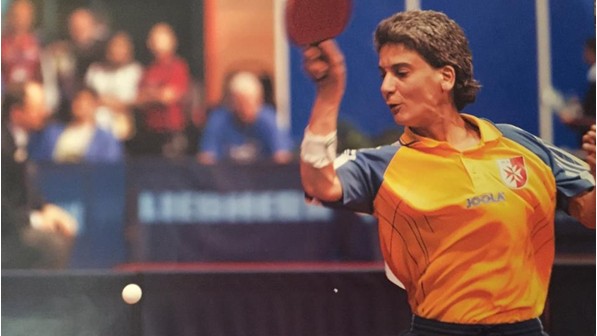
At 58 years of age, Johanna Grech continues to live table tennis with the same intensity that first drew her to the sport decades ago. Today, she serves as Deputy President of the ETTU Gender Equality Committee, where her work focuses on advocacy, inclusion and creating fair opportunities for women across European table tennis. Coming from Malta, one of Europe’s smallest table tennis nations, Grech believes that limitations are often more internal than external. “The greatest obstacle is often ourselves,” she says. “Participating in different roles – as a player, an official or a coach, comes down to mindset and determination.” That mindset was shaped early. Her journey began in a family garage, a modest setting that ignited a lifelong passion. From there, she progressed to the National League and earned the honour of representing Malta on some of the sport’s biggest stages: World Championships, European Championships, the Games of the Small States of Europe and the European Mixed League. Her international path also took her to Italy, where she competed for three seasons. Between 1983 and 2007, Grech was a constant presence in international competition, a period she describes as formative not only for her sporting career, but for life itself. Over more than two decades, she held the title of national champion, while also securing podium finishes for Malta at the Small States Games and in the European Mixed League. Some of her most meaningful experiences came at World and European Championships, where competing against larger nations brought both challenges and lessons. “Some of my proudest moments came while competing at the World and European Championships. Representing Malta, I celebrated both victories and the unique challenges of being from a country with limited resources and fewer opportunities for international exposure. Facing larger European nations taught me resilience, and my determination helped me leave a meaningful mark for Malta in the sport, but this was not enough, I knew that as a player I reached my MAX. I searched for more opportunities within the sport.” That realization opened new paths. GRECH transitioned into administrative and governance roles, serving on Malta’s National Council, being elected to an ITTF Committee, and later becoming a full member of the Technical Committee from 2005 to 2007. These roles allowed her to influence the sport’s development while upholding principles of fairness and equality. Her commitment deepened when she became Secretary General of her National Council, focusing on strengthening the domestic table tennis community. Election to the National Olympic Committee of Malta followed, further expanding her ability to support sport at a national and international level. Today, GRECH remains active both on and off the court. As a coach at a local Table Tennis Centre, she works closely with young players, passing on not only technical knowledge, but values shaped through decades in sport. At the same time, her role within the ETTU Gender Equality Committee allows her to advocate for inclusion and visibility across Europe. “My role as Deputy President of the Gender Equality Committee of the ETTU allows me to champion inclusion, fair play, and create opportunities for women from every corner of Europe who wish to join one of the world’s oldest sports. Through these positions, I strive to make table tennis more accessible and welcoming, supporting anyone who dreams of participating, regardless of their background or previous experience. Table tennis helped me grow as a person. The discipline, teamwork and perseverance I learned through the sport still guide me in everything I do.” GRECH continued: “Table Tennis is a sport that helped me grow as a person, strive for my dreams, and achieve results both on the table and beyond. Throughout my journey, the values learned through intense training, competition, and teamwork have profoundly shaped my character and outlook. The discipline and perseverance fostered by the sport have not only brought success in matches but also instilled life skills that continue to guide me in every aspect of my personal and professional life as a director in the National Olympic Committee and as deputy President of the Gender Equality Committee of the European Table Tennis Union.” Her message to future generations, especially to women coming from smaller countries, is clear and unwavering: “Size does not define your future.” Are Things Better for Men? Alongside stories like GRECH’S, the Gender Equality Committee continues to gather data to better understand the reality for female players. A short survey conducted during the European Championships in Zadar collected around a dozen responses from players, a small sample, but one that still offers insight. One recurring theme concerned competition schedules, with women often playing early in the day while men’s finals conclude events. At national level, respondents felt that male players are still, in many cases, slightly better supported than female players. Encouragingly, perceptions were more positive when it came to ETTU competitions, suggesting progress at the European level. While the results are indicative rather than definitive, the Committee sees this as a starting point. As Johanna Grech’s journey illustrates, meaningful change often begins small – but with persistence, it grows.

How is women’s table tennis developing in Europe?
As part of ETTU’s ongoing commitment to inclusion and development, an analysis of gender-related data submitted by 41 of ETTU’s 58 registered Member Associations in 2025 provides insight into participation trends across European table tennis. The findings highlight encouraging progress in some areas, while also pointing to where further efforts can make a difference. The Gender Equality Committee collected information relating to participation by gender across playing, officiating, coaching, governance and administrative roles. The aim was to better understand membership structures and identify opportunities to support greater gender balance across European Table Tennis. Where we stand today Across the Member Associations that responded, women currently represent around 20% of registered players. When participation is analysed on a per-association basis giving equal weight to each Member Association the figure rises slightly to just over 21%. This confirms that while female participation is present across Europe, it remains uneven and continues to be an important area for development. It should be noted that all responding Member Associations allow members to self-identify their gender at registration, and none apply verification checks. Positive signs at youth level One of the most encouraging findings appears in youth categories. Among U19 players, female participation reaches almost 28% on average per Member Association, suggesting that more girls are entering the sport than in previous generations. This points to the positive impact of grassroots initiatives and youth programmes, even though further efforts are still needed to move closer to balanced participation. Retaining women in the sport remains a challenge While youth participation shows promise, female representation decreases in older age categories. Among veteran players, women account for around 17% on average per association. This highlights the importance of not only attracting girls to table tennis, but also creating environments and pathways that support long-term engagement and continued participation throughout adulthood. Beyond playing: pathways into roles and leadership Female representation is lower in roles such as coaching, officiating and governance. Based on the data provided, women represent approximately 24% of coaches on average per association and account for around 23% of board members Some associations report higher percentages of female coaches, including Estonia, Latvia and Guernsey. Others, such as Italy and the Netherlands, stand out in absolute numbers of female coaches despite having overall female player participation close to the European average. This suggests that increased female coaching representation is not solely driven by a larger female playing base and may reflect different development or recruitment approaches. At governance level, the average association board in Europe consists of around 10 members, with approximately three women, although significant variation exists between Member Associations. Female representation is notably higher in administrative and professional roles within Member Associations. On average, women account for around 44% of association staff, suggesting that organisational environments within European table tennis are closer to gender balance than playing, coaching and officiating pathways. Officiating: challenges and opportunities Across the responding associations, nearly 2,200 national umpires are registered, with an average of around 70 per association. Of these, 345 are women, representing a relatively low proportion. Given that officiating is accessible across genders and abilities, this area presents a clear opportunity to further increase female participation. At international level, 496 international umpires are registered, with 87 identifying as female. Latvia and Azerbaijan report higher-than-expected numbers relative to their size, although overall figures remain low. Policy context and awareness At the time of data collection, no ETTU Member Association reported having a formal Transgender and Non-Binary Policy in place. However, all associations expressed interest in the work currently being developed by Table Tennis England, which is undergoing consultation and review. Member Associations were also asked whether completing the survey changed their initial assessment of gender equality within their organisation. Only a small number indicated a change, suggesting that awareness alone does not automatically translate into reassessment. Looking back: what has changed since 2020? While the data collected in 2025 differs in scope from that gathered in 2020, a comparison of common indicators ,including players, coaches, employees, board members and umpires, offers useful context. Across these comparable categories, female representation has remained broadly stable over the past five years, with no major structural shift at the European level. Different realities across Europe The data highlights significant differences between Member Associations. Some report relatively balanced participation and strong female representation across roles, while others face greater challenges due to size, history or structural factors. Looking beyond total numbers helps identify positive examples and opportunities for shared learning across Europe. Moving forward together Overall, the 2025 data provides a valuable snapshot of gender participation in European table tennis today. It confirms that progress is being made in certain areas, while also reinforcing the need for continued focus on retention, visibility and leadership pathways for women and girls in the sport. By continuing to share data, experiences and best practices, ETTU and its Member Associations can work together to build a more inclusive and sustainable future for table tennis across Europe. Sally HUGHES & Galia DVORAK